




The Strange Universe of Gravitational Lensing & Quasars | Space Time | PBS Digital Studios
Einstein determined that massive objects cause a distortion in space-time, which is felt by gravity.
The curvature of space-time tricks out eyes. Much of the deep universe is shifted and magnified by the warping effect of gravitational lensing. In the world of our mind’s eye, light travels in straight lines, we just catch photons with our eyes and trace their paths backwards (refracted into our retina), this works when the light paths are straight, but if you add a pool of water or a glass lens our internal model fails, we perceive illusory and distorted images as our mind’s eyes tries to enforce over-simplistic physics on a complex reality. It turns out that the whole universe is a giant distorted mirror, many things are not where or what they seem. In the real universe, both space and time can be curved. And the path travelled by light follows the curve.
Einstein’s general theory of relativity describes the real universe as flexible, dynamic dimensional grid that only resembles our mind’s eye Euclidean lattice in the absence of mass and energy. The curvature produced by mass gives gravity, light follows this curvature, and so gravity bends the path of light.
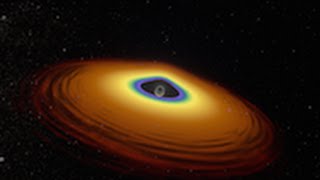
The gravitational field of any massive object converges passing light rays, like a badly designed lens. Gravitational lensing has become a very powerful tool for studying the universe. An example of gravitational lensing is the Einstein Cross, four images of the quasar appear around the galaxy because the intense gravity of the galaxy bends the light coming from the quasar. The quasar is powered by a supermassive black hole feeding on its surroundings, a vortex of superheated matter falls into a black hole. Each of the images is one quasar, viewed via four different paths through the universe. The nearby spiral galaxy gravitational field bends space-time to create these paths. By measuring the time delay between fluctuations we can measure the distance travelled, lensing distance measurements have allowed us to measure the Hubble Constant, which tells us the rate of expansion of the universe.
The most extreme gravitational bending is the black hole itself. Light falling below the event horizon is lost forever, outside the event we find the most extreme gravitational lensing in the universe, the photons orbit the black hole, forming a shell of light.
Next time you look at the sky, remember your eye is following a strange curved paths, stars are all brightened, shifted and warped by lenses of a curved space-time.
Comments